Friday, May 31, 2013

cow catcher

Had a nice back and forth over the weekend with a UK cattleman on twitter and he mentioned a cow catcher that mounts on the front end loader of a tractor. Having just come off a call to treat a pinkeye case that required a lot of coaxing, ropes, and mild rodeo effort, this sounded very useful.

And i think it is - have a look at the full series of pictures on this blog he provided me.
 http://anorfolkfarmer.blogspot.co.uk/2010/05/cow-catcher.html

His is a telescoping version and as the cows are often quite used to having tractors in the field around them(carrying round bales)they often and usually can be just driven up to and have the 'corral' drop over them. Great for pastures far from home corral - also was suggested (and many thanks to Andrew Holding @andrewholding1 for passing on all this info)that it was very useful for a newly calved cow to help get the calf sucking and tagged, leave them in for a few hours. Or *walking* cattle in them to get them closer to home.

Much as I love my lariat(and try to keep it hidden unless absolutely needed)this looks like a great piece of equipment to reduce cow(and owner - vet)stress and allow quick more easy treatment when cattle are on summer pastures.

Sunday, February 24, 2013

March Madness time is back at UPenn New Bolton


(this is an updated version from past years - it is an annual event worth taking advantage of if needed)

The Annual Food Animal Rotation at New Bolton Center offers good discounts for bovine/small ruminant surgery and medical cases referred in to Penn for treatment in the next several weeks. Not only a good savings for you, but helps out students to see 'normal' cases that they will be encountering in practice. (I know this as a member of the original March Madness crew in 1989). Have a calf with a hernia? Great time to have her repaired. 

There is a continuing 'twist' this year - the first 8 LDA's of each 2 week rotation will be done for free, and for other cases they will pretty much offer a free evaluation and depending on the nature of the problem, can discuss cost of treatment and discounting.  

It starts today Monday, February 25th and goes for 4 weeks through March 24th. Take advantage of the expertise at Penn Vet, save some money and help your cattle, sheep, and goats, not to mention future livestock veterinarians. 

Friday, November 16, 2012

'Tis the season - treat for lice

late winter hair loss due to lice
Now is the season in late autumn to treat cattle for lice, before further buildup occurs - this will prevent the clinical cases we're used to seeing in mid-late winter as cattle rub off hair. The denser winter coat and cooler favors survival of lice. The period from Halloween to Thanksgiving is an ideal time to treat.

Two types of lice occur in cattle, biting and sucking. Normal treatments are pour-on products(like Synergized De-Lice, pour-on avermectins, like Ivomec, Dectomax, or Cydectin). The pour-on avermectins also have the advantage of controlling internal parasites at the same time, also a good time of year to ensure no carry-over of worms picked up during the grazing season. If you are using Safeguard or Valbazen to deworm your herd in fall, consider also using a pour on like De-Lice or UltraBoss. One note - some of the pour-on avermectins will control just sucking lice, not biting lice. Check your labels and use as appropriate.

Treatment prevents the damaged coats, and hides of the animals. Additionally there is often damage on farms  of fencing or other items from the rubbing that is done. Once treatment is done, have a look in several week or at next herd visit to see the degree of infestation that is remaining, if any.  A secondary treatment may be necessary, but no adult live lice should be found at that time after initial treatment.

Have a good Thanksgiving!

Monday, October 8, 2012

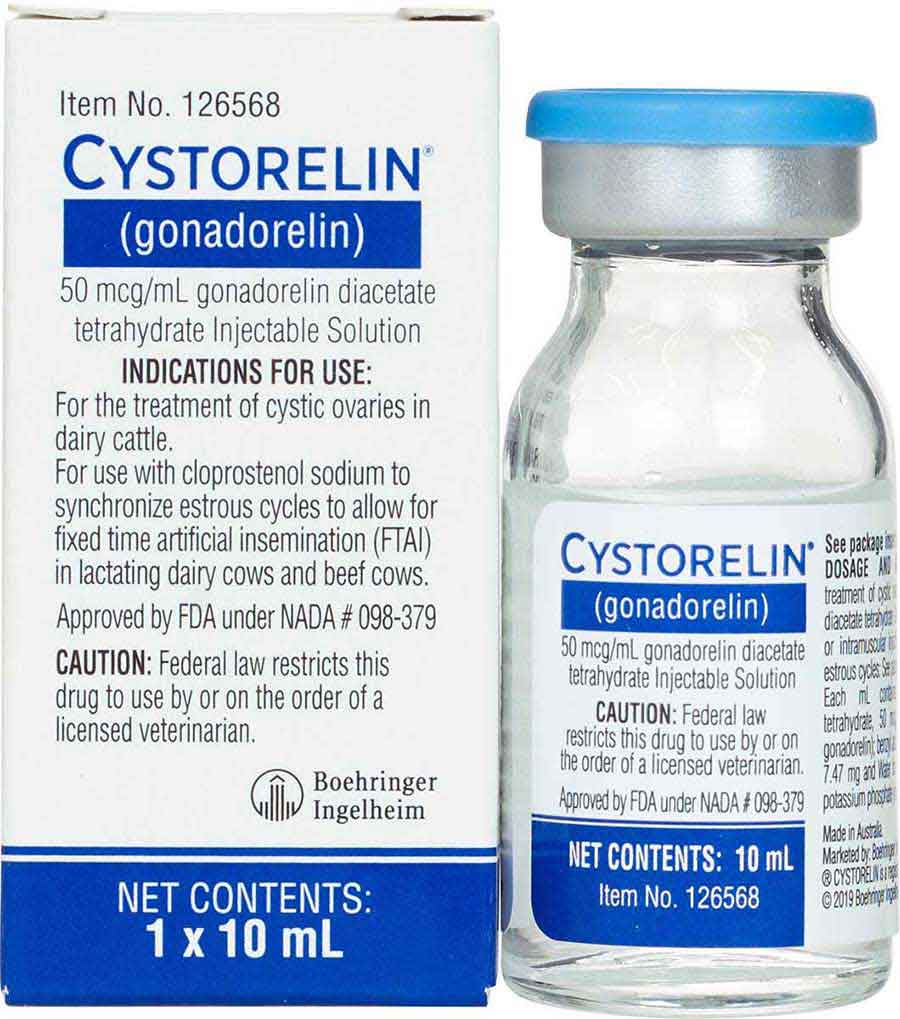
Cystorelin GnRH label change

Merial has announced that the conditions for storing Cystorelin/GnRH have been changed and the label updated.

It now can be stored at room temperature - and doesn't have to be refrigerated. (this is something that has been mentioned unofficially in the past from company tech people, but now glad to see it approved and on the label.). What conditions?

Room temperature(77F or below)is fine - brief exposures to 86F are okay too. If it's opened, and unused after 6 months, discard the bottle.

This is an important point and a good time to reinforce something mentioned often in proper use of GnRH. It is a polypeptide - like a small protein chain and can easily be damaged by contaminating bacteria. That's food for them. Get a contaminated vial and then you end up injecting pieces of GnRH with no activity. When you inject Cystorelin, always and only use a new needle to pull from the vial. If you have a partial vial left, before taking a dose from bottle, wipe the top with an alcohol swab and give it 30 seconds. You don't want to waste the drug and especially waste the effort of getting a response from your cow on an OvSynch or other program. I've recently swabbed some tops of medicine vials on cattle farm medicine cabinets and the growth on a normal blood agar plate is eye-opening.

So this goes for all medicine on the farm. Keep in a clean spot, new needles and swab the tops in certain cases. The advantage on this label change for Cystorelin is easy shipping over the weekend without ice packs.

Tuesday, September 18, 2012

less stress vaccination

Last weekend at the Beef Field Day at Riverbend, one of the topics in the herd health talk was proper immunization of calves prior to weaning.

With weaning time getting close, now is the time to work those calves to give them the best advantage and protection, not only for immediate post-weaning time, but for their entire productive life.

The importance of an initial modified-live vaccine(such as BoviShield Gold 4L5), particularly with regards to BVD, can't be overstated. It provides them with superior immunity to just killed and allows formation of immune components that give them the ability to maintain protection later in life with just one BVD booster per year. The nice thing about MLV too is lower volume, easy to give, costs less and does more! That's a good(and rare)combo.

Most importantly, by giving this vaccine pre-weaning, you're giving it the best chance to work(to effect immunization, not just vaccination)by keeping the stress low. Calves go back to the dams, familiar environment, then in 3-4 weeks when actually weaned, they have added protection on board already.

Questions about when and how to time this, combinations that work best in your particular herd, just ask at next herd visit or call/email anytime. Happy and healthy weaning!

Thursday, September 6, 2012

NJ Beef Field Day at Riverbend Farm

This Saturday the 8th, come to Riverbend Farm in Far Hills for a beef field day - Corne has lined up, along with the NJ Angus Association, NJ Beef Council and Rutgers Cooperative Extension a great day starting with informative programs, a light lunch at the farm, and tours afterwards. Programs will cover areas such as Beef Quality Assurance and carcass issues, heat synch/AI topics, current health programs for small and larger beef herds and calving/difficult calving-dystocia topics.

Give a call to 908-788-1338 with who is coming or email Hunterdon Ag Agent Bob Mickel at Michel@NJAES.Rutgers.edu so they can have a lunch count. Or feel free to to give me a call or email(or text!)here and i'll line you up for the day.

Looks like good weather that morning, so take a drive and stop over for a fun and learning Saturday. And see some really good Angus cattle and see fellow beef breeders. They're at 25 Branch Road in Far Hills.

Tuesday, March 6, 2012

March Madness time is back at UPenn New Bolton


(this is an updated version from past years - it is an annual event worth taking advantage of if needed)

The Annual Food Animal Rotation at New Bolton Center offers good discounts for bovine/small ruminant surgery and medical cases referred in to Penn for treatment in the next several weeks. Not only a good savings for you, but helps out students to see 'normal' cases that they will be encountering in practice. (I know this as a member of the original March Madness crew in 1989). Have a calf with a hernia? Great time to have her repaired. 

There is a continuing 'twist' this year - the first 8 LDA's of each 2 week rotation will be done for free, and for other cases they will pretty much offer a free evaluation and depending on the nature of the problem, can discuss cost of treatment and discounting.  

It starts tomorrow Monday, February 25th and goes for 4 weeks through March 24th. Take advantage of the expertise at Penn Vet, save some money and help your cattle, sheep, and goats, not to mention future livestock veterinarians.